
For Hero MotoCorp, India's largest two-wheeler company, it's a calculated gambit to revive Harley-Davidson whose ride in India has been anything but easy since it got here.When automotive firms embark on alliances, it's a roll of the dice on how such marriages will play out.

The growth momentum that started during the festival season is likely to sustain in the new year, reports Arindam Majumder.

The auto industry has had a mixed month. The build up to Dhanteras and Diwali was good but the demand tapered off subsequently.

The passenger car segment, in comparison, remained sluggish and grew a modest 1.9 per cent to 162,566 units in April

The industry needs stimuli to help revive consumer demand and conversions.

Honda, Bajaj, Yamaha and Mahindra are revving launch plans for the 200cc and above motorcycle segment.

In May, Satpal Singh, who runs a dairy business with three buffaloes in Jewar, near Noida, was worried about the steep spike in input costs. Singh said dry fodder rates, which cost Rs 1,500-2000 per tractor trolley last year, were quoting at Rs 4,500-5,000. The price of other cattle feed ingredients (that include mustard meal and similar mixes) had also gone up from Rs 2,000 per quintal to Rs 3,100-3,200 per quintal.
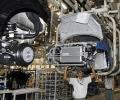
Hyundai Motor and Toyota Kirloskar Motor have announced the suspension of manufacturing operations at their respective plants amid coronavirus outbreak. On Sunday, various automakers like Maruti Suzuki India, Honda Cars, Mahindra & Mahindra and Fiat announced a temporary halt in manufacturing operations at their respective facilities.

After the easing of lockdown in mid-May, auto companies were able to resume production in a phased manner, but the ramp-up was slow due to a broken supply chain, and lockdown-induced restrictions.

Maruti will showcase its first concept electric vehicle, the e-SURVIVOR; M&M it's six new EVs, including two futuristic concepts

Over 22 passenger and commercial vehicle makers and 18 two- and three-wheeler makers will take part amid proximate security.
The company, known for its products such as two-wheeler crank shafts, under brackets, transmission gears, steering knuckle, bevel gears and spindles, has decided to shut all operations at its Chinchwad plant between December 1 and 17. The company, which also had a plant in Chakan that was later taken over by Mahindra Automotive, has been a known name in auto component business.
Cheap imports from China threaten to punch a huge hole in the business of local automobile component makers.

India has a history of jugaad, and retrofitting vehicles is one such manifestation of the legendary Indian skill. Not so long ago autorickshaws and small Marutis used to strap on subsidised LPG cylinders and power themselves to a cheap ride. There were the odd explosions, lives were lost, but the jugaad continued. Then compressed natural gas (CNG) was introduced in Delhi following a court order. Initially, customised CNG kits were fitted to conventional (internal combustion engine or ICE) autos cheaply, enabling commuting at less than half of what you would cough up for diesel. The industry is better organised now with Suzuki and Hyundai designing CNG-fired vehicles, and Mahindra and TVS manufacturing liquefied petroleum gas (LPG)-powered three wheelers.

Bajaj Auto fears adverse impact on its exclusive loan deal with Bajaj Finance

Product launches to drive incremental volume growth for players such as Maruti Suzuki; medium and heavy commercial vehicle revival on track.

The NSE Nifty gained 77.85 points, or 0.71 per cent, to finish at 11,008.30. Intra-day, it shuttled between 10,821.55 and 11,035.65.

Barely a month after breaking covers, the models -- the Jawa, the Jawa 42 and the Perak -- were sold out, reports Shally Seth Mohile.

'I have personally been very keen on investing in lithium ion battery technology for some time.'

Leading automakers Maruti Suzuki India, Hyundai Motor, Kia Motors and Tata Motors reported sales growth in the domestic market in November, aided by robust offtakes amid the festival season. While Maruti Suzuki India reported marginal growth, Hyundai logged in its highest ever monthly sales in November. Others like Honda Cars India, Toyota Kirloskar Motor, Mahindra & Mahindra and MG Motor India also reported sales growth in November as compared with the same month last year.

India's equity markets are on a roller-coaster ride, after delivering spectacular returns for two consecutive years - in 2020 and 2021. The benchmark National Stock Exchange's (NSE's) Nifty50 is down 1.5 per cent in the first nine months of the current calendar year 2022 (CY22) as foreign portfolio investors sold Indian stocks due to rising bond yields in the US and across global markets, including India. The sell-off in the Indian equity markets has, however, not been broad-based and largely limited to sectors facing earnings headwinds from rising interest rates, lower commodity and energy prices, and likely economic recession in advanced economies.

An EV has to be purchased along with the battery as there are hardly any battery swapping, rental, or leasing business models available across India.

Pawan Munjal, chairman and managing director of Hero MotoCorp, the country's biggest two-wheeler maker, leads the pack among automobile CEOs.

Tata Motors, Hero MotoCorp, Ashok Leyland, M&M are up 3-6% on BSE.

There are four things that stand out in China's strategy for electric vehicles, says Vandana Gombar.

While home-grown firms like Tata and Mahindra have been actively participating in the government's e-mobility mission, by launching electrified versions of their existing models, the global firms believe electric is not the best solution for a country where the primary source of power generation is coal, and where infrastructure is a big impediment.
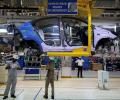
Availability of jobs at India's auto companies has shrunk significantly over the last two years, as the industry goes through one of its worst slowdowns. More than 60 per cent of the total workforce fell by 24 per cent in 2019-20, against 2017-18.

M&M also saw its domestic passenger vehicle sales grow by 1 per cent, while Toyota Kirloskar Motor witnessed a decline in its PV sales.

Maruti, Hyundai, Tata Motors, Mahindra & Mahindra and Honda saw their passenger vehicle sales improve in August compared to the same month last year, although Ford and Toyota witnessed a decline.

Even as India goes green, lack of uniform standards for setting up charging stations is holding back companies. Alnoor Peermohamed reports.

The total dividend income for seven firms grows 25%.

IT sector replaces auto sector after a 6-month gap.

Maruti Suzuki, Hyundai and Mahindra failed to register significant growth.

Striking workers lacked support in the Pimpri-Chinchwad-Chakan belt.

Close to 50 models were launched in India in the past 12 months, but companies have not been able to realise their potential due to the pandemic.
Normal monsoon makes FMCG, automobile and consumer durable companies optimistic about growth prospects

Most of the leading vehicle manufacturers were before the court, though their stand was not identical and sometimes contradictory.

These companies had threatened to leave Maharashtra and invest in other states when the state government had brought amendments to the Maharashtra VAT Act with effect from April 1, 2011, and made net sales the basis for VAT set-off claims.

Maruti Suzuki, Hyundai, Honda Cars and Tata Motors posted single digit growth during the period under review while M&M reported decline in sales.
